Interview with Michka Melo

At the occasion of a week of citizen science research with my friend Michka Melo in Foam Brussels, I took the opportunity to record an interview. Michka talks about his atypical background, urban gardening, biomimicry, upcycling, future scenario, art and science collaboration. Inspiring and very well informed views on cutting edge topics!

An account of our experiments is available here. Thanks to Robert Murray Smith for valuable info on DIY supercapacitors.

Brussels visits: Foire aux savoir-faire

After another citizen science experimental day in Brussels, Michka and I went along to a recycled goods workshop in the premises of la Foire aux savoir-faire (know-how fair). In a similar way to Hacker Space Brussels we visited two nights before, la Foire aux savoirs takes over several levels of a town house in the city centre. We arrived at the end of the workshop, where a small group was assembling Brazil inspired ornament with recycled corks and bits. We had a good chat with one of the main organisers, Damien, about the vision for the organisation.

As implied in the name, members and visitors are invited to share skills in all sorts of domains, from cooking to knitting to designing alternative energy sources. The top floor is crammed with donated material to be upcycled. The attic also hosts an ominous methaniser tank, a device that generates usable methane gas from organic waste, potentially enabling the operation of a cooker or other heating device.

La foire aux savoir-faire is always on the lookout for volunteers and driven by an enthusiastic team, pay them a visit if you are around this part of the world!

bxSavoirView

Brussels visits: HSBXL

While in Brussels on a DIY supercapacitors experiment with Michka Melo, we visited local organisations related to creative technologies. First we went to HSBXL, Hacker Space Brussels. The organisation occupies a whole house in the city centre, complete with a pleasant garden. We had a chat with local hackers who hang out in HSBX every Tuesday evening, very competent with feral networking and GNU.

hackerspaceBrusselsSign

Typically for such a place, there were piles of old IT becoming e-waste, a few 3D printers in various states of operation, soldering irons and scattered workstations. The bar was well stocked, with bottles of mate in different flavours seemingly the drink of choice among coders in these quarters. An open source stock management system rules the fridge, and a cavernous voice announces new visitors.


We saw a book-scanning device, an in-progress ominous suitcase server with self destruct capabilities and an hydroponic tank full of healthy tomato plants… We walked out with a bunch of dead laptop batteries for our experiments, thank you HSBXL!!

bxPhauneRadio

On the garden table I found a sticker for Phaune Radio, an internet station that plays engaging mixes of non-mainstream music and animal-themed spoken material, recommended.

Experiments in DIY supercapacitors

Just back from Brussels where I worked for 5 days on DIY supercapacitors with my inspiring friend Michka Melo. We worked on the premises of the equally inspiring organisation Foam, trying to build supercapacitors from upcycled computer batteries and other methods including chemically altered cuttlefish bone, in a true citizen science spirit!

[Supercapacitors are electrical storage devices that become a viable alternative to conventional batteries, making up for lower capacity with a very fast charging time and much longer life.]

Michka compiled a detailed account of our experiments. Thanks to Robert Murray Smith for valuable info on DIY supercapacitors.

Coucou clock making in Cévennes

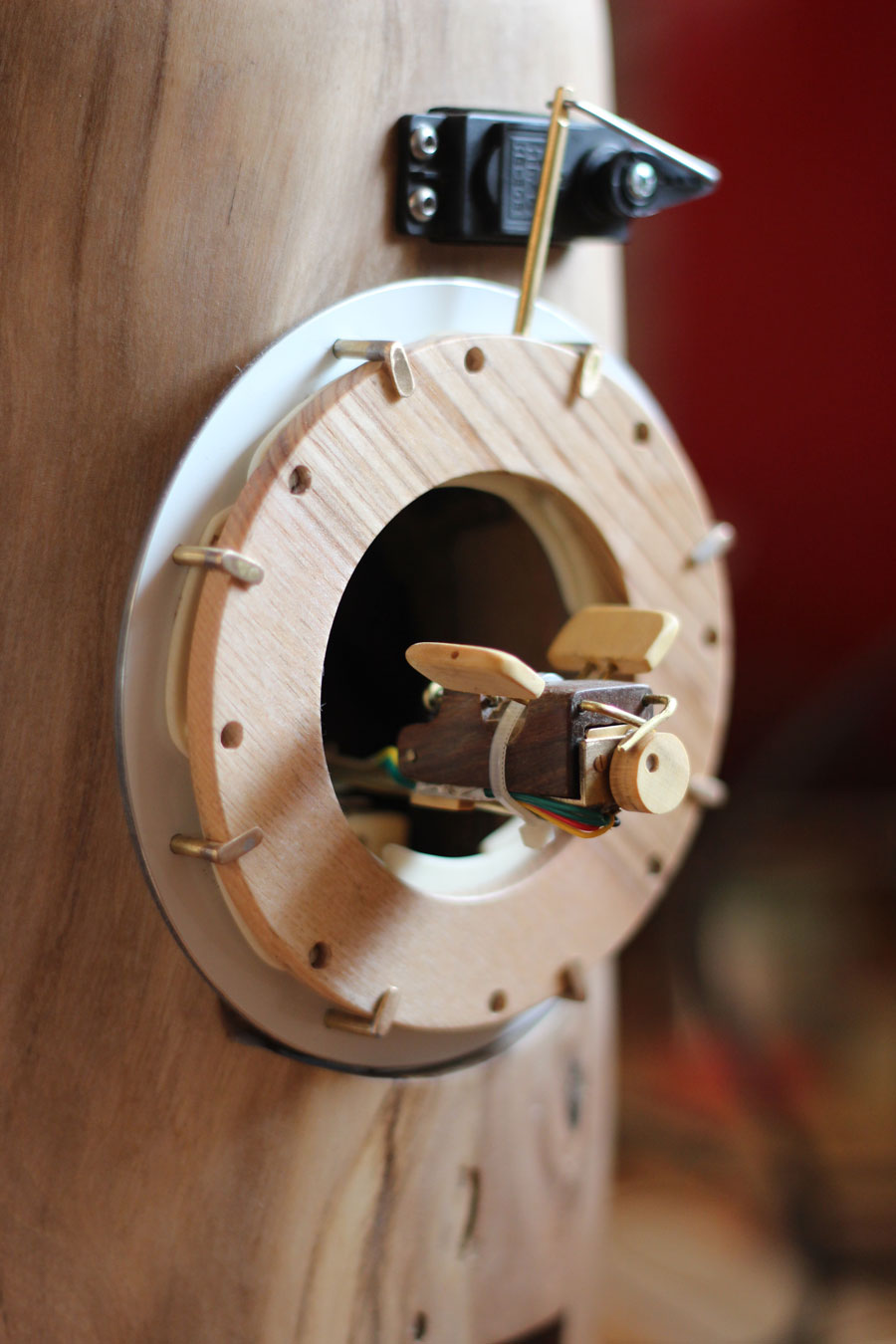
I spent a week near Alès in the south of France, sharing tricks with the multi-talented William Brossard, founder of Artimachines. We started building a hybrid cuckoo clock using various techniques ranging from walnut tree sanding to Raspberry pi programming. The coucou bird is working nicely, coming out of a circular door designed by William. The clock runs on a Raspberry Pi fitted with an Adafruit PiTFT monitor. The bird and door are controlled by an Arduino Uno and a L298 motor controller.

I am thinking of changing the display as the PiTFT display is dim in daylight and when seen at an angle.


coucouJune

Is Technology Eating My Brain? the machines

Several works were developed for the  Is Technology Eating My Brain? exhibition:

Geranium Survival Unit

geraniumSurvival1PicBanner
Pedal-powered automated watering and lighting system for a geranium
………………………………………………………………………………………

techEatBrain Litany

techEatBrainLitanyBanner
Endless computer speech declining public opinions on technology
………………………………………………………………………………

Big E-Waste Tech Head

bigTechHeadBanner
Participatory sculpture made of upcycled e-waste
…………………………………………………………..

Slicing Photo-Booth

slicingBoothBanner
Self-portrait machine with random slice-mixing function


Is Technology Eating My Brain?

Is Technology Eating My Brain? poster

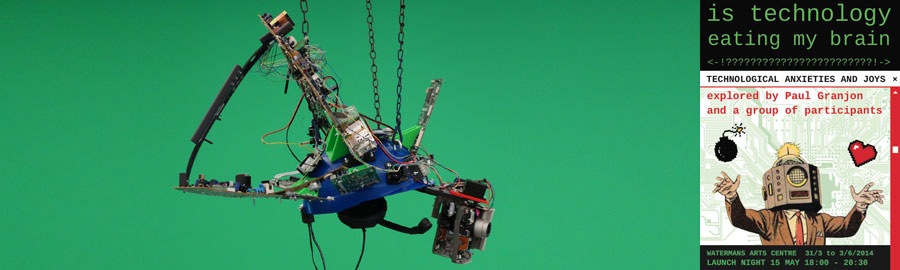
My residency-exhibition Is Technology Eating My Brain? at Watermans Arts Centre Brentford West London is going well. The project is based on my Wrekshop idea. The principle consists of installing an e-waste upcycling unit in a gallery space, opening it to voluntary participants and build exhibits over the period.

techeatbrainPosterPic

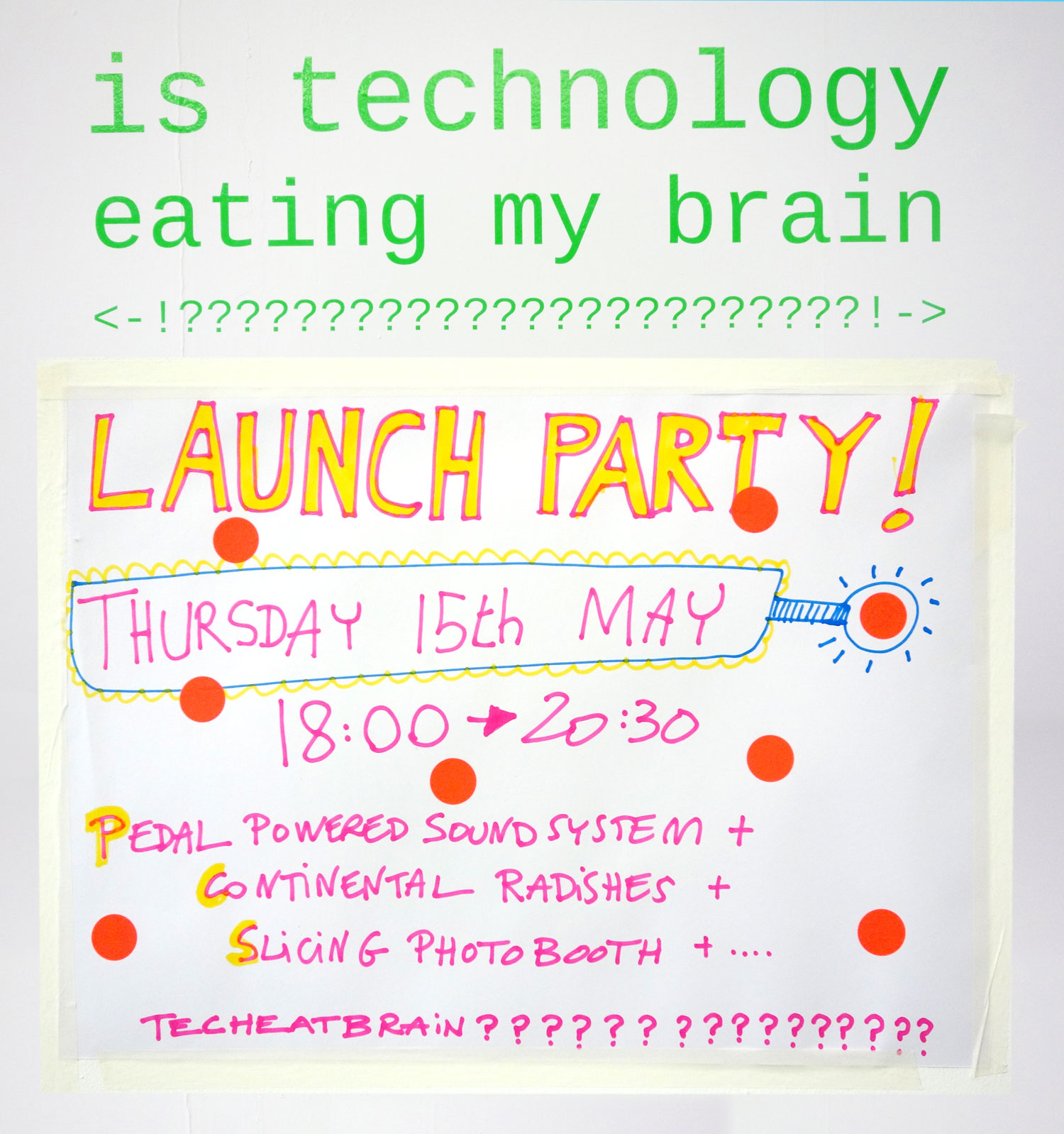
The residency part of Is Technology Eating My Brain? at Watermans Arts Centre has concluded with a launch on 15th May. Visitors had a chance to mingle among a Geranium Survival Unit, a Slicing Photo-Booth, eat French style radish snacks (raw with a chunk of butter and some salt), play tunes on a pedal-powered sound system provided by Pedal PA.

techEatBrainOpeningPics

Other works include the techeatbrain Litany, a growing list of “Technology is…” statements read by a speech synthesizer running on an old PC retrofitted with Linux Crunchbang and espeak. Visitors can enter statements to the list which was started by myself and participant Toby Lynch. The soundscape is completed by an audio mix of atmos sounds I recorded in Australia and Japan.

Participants Jason Scording and Bobby Neighbour contributed greatly to the Big E-Waste Helmet of Tomorrow, a bulky just-about-wearable headset featuring mobile photographic eyes made of hacked 2 megapixel vintage-ish cameras. The Slicing Photo-Booth was programmed on Raspberry Pi by Vagmakr. Eugenie Smit put together a delicate assembly of small devices triggering one another (see below).

The exhibition runs until June 3rd

eugenieDevice

Recycling plastic for 3D printing

absShredsBanner

I have been using basic 3d printers since 2011, starting with a Thing-o-matic  by Makerbot, then a couple of UP3D machines. They use plastic filament, mostly made of Acrylonitrile butadiene styrene (ABS), the same material used to make Lego bricks, or polylactic acid (PLA), a plastic derived from corn starch or other renewable bio-materials. The filament is generally made from virgin plastic (ie: not recycled), purchased ready-spooled and in various colours.

The frequent use of a 3D printer has a common side-effect: the production of a significant amount of faulty parts and temporary support structures, without even counting in the endless tat spewed out by the little machines in the guise of Yoda heads, clumsy plastic jewellery, door knobs that don’t quite work…

Additionally ABS plastic perfectly suitable for printing can be found in the casings of many consumer electronic items, car bumpers, fridge door compartments, lego bricks, luggage etc… The problem is how to turn this abundant source of potentially upcyclable material into suitable filament. The most spectacular and impressively robust use of recycled ABS in a 3D printer is Endless, a project by Dutch designer Dirk van der Kooij based on a modified robotic arm.

The search for an environmentally friendly solution to the needs of desktop 3D printers is underway. The Filabot was probably the first attempt for an open-source solution allowing both the re-use of discarded prints and of recycled plastics. Filabot is now providing a commercially available grinder, the Reclaimer, as well as different models of filament extruders.


Other commercial designs include and the Strudittle and the Filastruder. Open source designs can be found on the Recyclebot website. Joshua Pearce from Michichan Technological University made the news in 2013 for his recycling of milk jugs using a Recyclebot v2.2, design available on Thingiverse. Beyond the fact that high-density polyethylene, or HDPE (the plastic milk jugs are made of) retracts dimensionally while cooling, the recycling of plastics presents the inconvenient that polymer chains do break down in smaller chains each time the plastic is melted, thus weakening the material and limiting the amount of useable cycles.

Filastruder recommends a pellet size of no more than 5mm width in any dimension for use with their machine. I experimented briefly with an office paper shredder and some of my discarded prints. The coarse plastic fragments I collected are not suitable for a small extruder, and the shredder struggled to cut anything thicker than 2mm.

plastic-in-indonesian-river

In November 2013 the UK based techfortrade charity launched the Ethical Filament Foundation, an initiative aiming to reduce plastic waste in developing countries while providing income to deprived populations. Their vision: ” We believe that there is an opportunity to create an environmentally friendly and ethically produced filament alternative to meet the needs of the rapidly growing 3D Printing market. We also believe that by doing this we could potentially open up a new market for value added products that can be produced by waste picker groups in low income countries.The foundation is working on a manufacturing and quality standard “.
 

Owl project studio

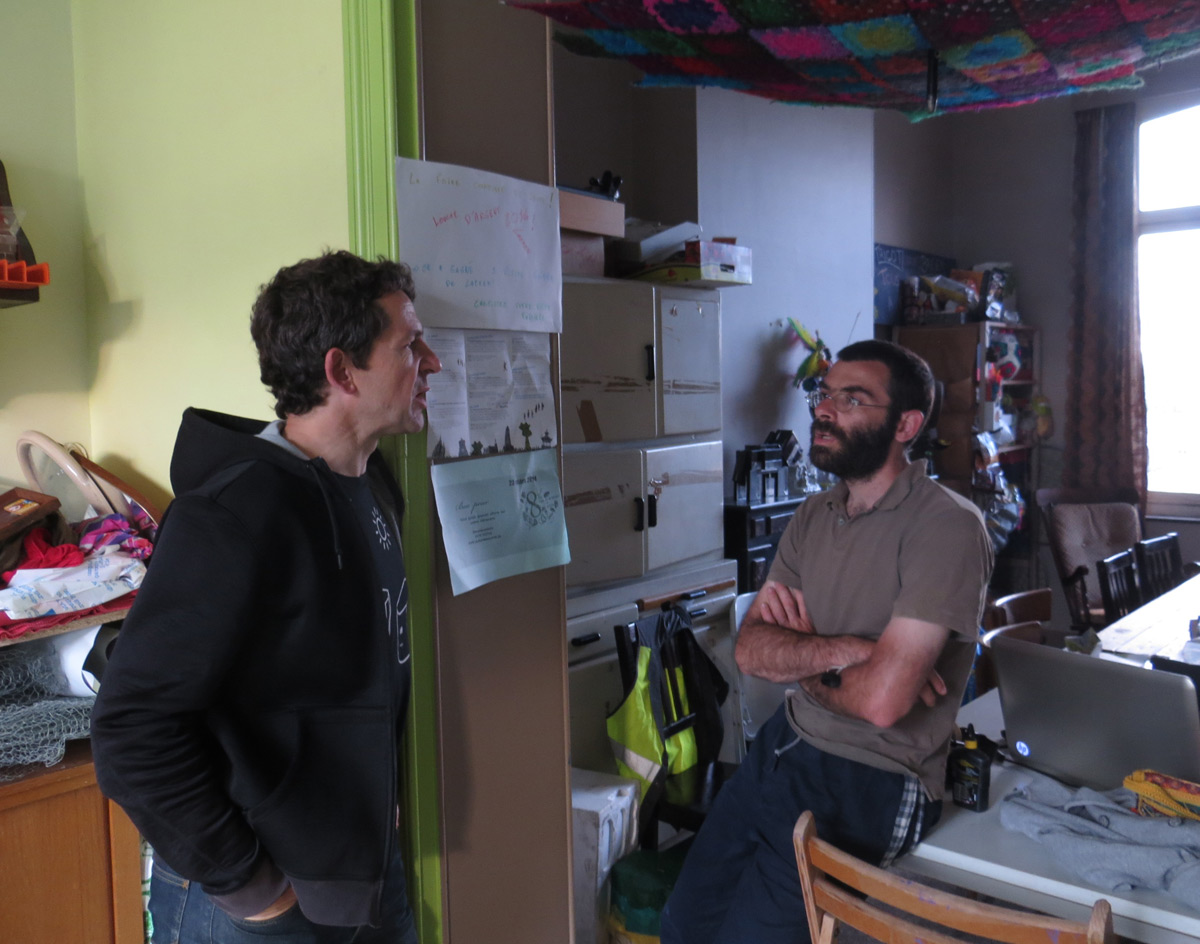
Owl Project's Anthony Hall and Simon Whitemore

While in Manchester I took the opportunity to visit my friends from the Owl Project in their studio round the back of Piccadilly Station. Anthony Hall, Simon Whitemore and Steve Symons have scored a large space split in two sections: one dedicated to (mostly) wood fabrication, with a CNC router and some more traditional cutting tools, the other for brain work, electronics and small scale projects.

The space contains several of Owl Project’s FLOW installation instruments. FLOW was commissioned by Cultural Olympiads fund in 2012, and installed on the Tyne River in Newcastle UK for several months. Mounted on a specially designed floating platform, a water wheel activated several beautifully crafted wood and electronics instruments that analysed water samples and generated sound accordingly.

I also saw a few solar-powered iLogs (if you want to make one, there is an iLog workshop coming soon) and current work on various synths, sequencers and light spectrometers. The Owl project are currently developing new work during a residency in Manchester Museum.

« Older Entries Recent Entries »